NVIDIA Partners with South Korea’s Ministry of Science to Invest in Next-Generation AI Startups Across Infrastructure, Robotics, and Enterprise Models
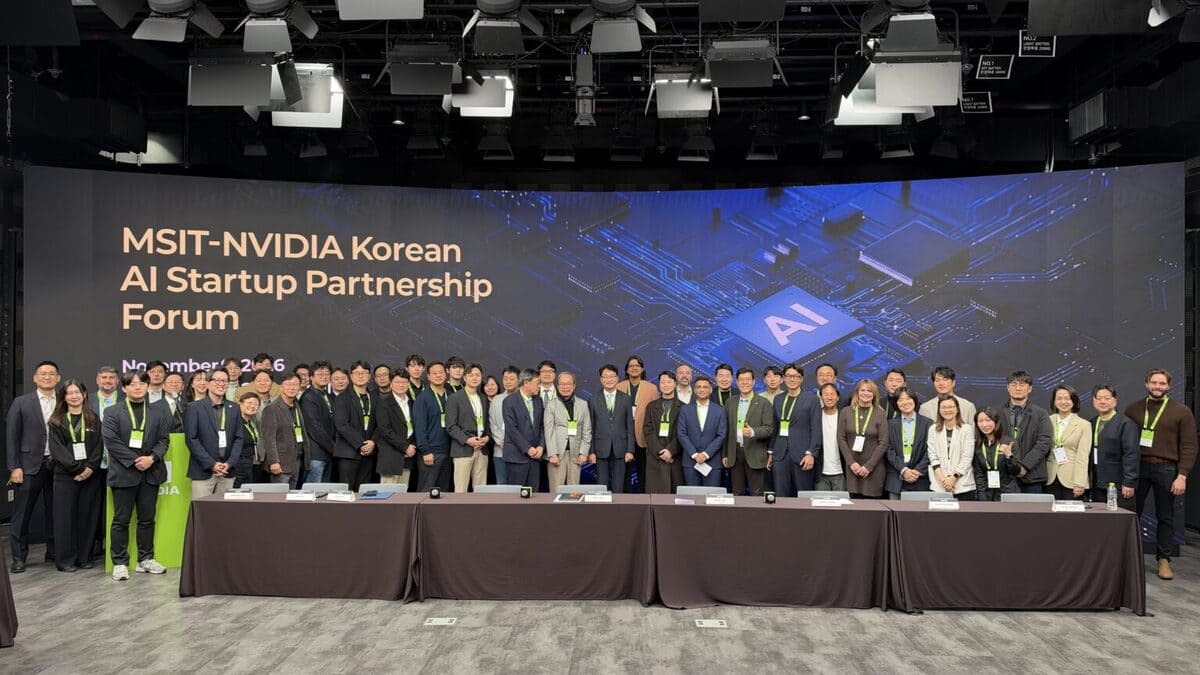
NVIDIA has announced new strategic investments in leading South Korean AI startups during the MSIT-NVIDIA AI Startup Partnership Forum at COEX in Seoul. The funding targets companies spanning the entire artificial intelligence technology stack, including AI hardware interconnects, agentic foundation models, physical robotics, and enterprise document AI. This joint initiative strengthens South Korea’s expanding AI ecosystem while building on the more than 1,000 local startups participating in the NVIDIA Inception program.
Pathway Investment Desk
New Delhi | November 11, 2026
NVIDIA and South Korea Join Forces to Accelerate Full-Stack AI Innovation
South Korea’s Ministry of Science and ICT (MSIT) teamed up with global tech giant NVIDIA to host the MSIT-NVIDIA AI Startup Partnership Forum at the COEX convention center in Seoul. The high-level gathering brought together government officials, NVIDIA executives, and representatives from more than 20 rising South Korean tech firms specializing in foundation models, physical AI, AI infrastructure, and AI semiconductors.
During the forum, NVIDIA confirmed an investment in Point2 Technology alongside plans for additional strategic capital injections into Motif Technologies, RLWRLD, and Upstage. Together, these four companies illustrate the breadth of innovation emerging from South Korea’s technology sector across every layer of the modern AI computing stack.
Breakdown of NVIDIA’s Target Startup Portfolio
| Startup Name | Core Domain | Key Technological Innovation | Primary Practical Application |
|---|---|---|---|
| Point2 Technology | AI Infrastructure | Radio frequency-based chip-to-chip interconnects | Scalable data movement between chips and racks in AI factories |
| Motif Technologies | Foundation Models | Open-weight agentic large language models (Motif-3) | Autonomous AI agents capable of completing complex tasks |
| RLWRLD | Physical AI & Robotics | Robotics foundation models with five-finger dexterity | Precision manufacturing, component assembly, and kitting |
| Upstage | Enterprise AI | Solar LLMs and specialized document AI tools | Extracting data from complex documents and workflow automation |
Deep Dive into the Supported Technologies
1. Next-Generation AI Infrastructure: Point2 Technology
Point2 Technology focuses on solving critical data bottlenecks inside high-density AI data centers and factories. By developing scalable, radio frequency-based interconnect solutions, Point2 offers a high-performance alternative to traditional copper and optical cabling. Their technology enables faster data transmission between chips and server racks, delivering the extended reach, signal integrity, and energy efficiency essential for scaling massive AI compute clusters.
Also Read and Subscribe to:
[ Technophile | Tech Insights LinkedIn Newsletter ]
2. Agentic Foundation Models: Motif Technologies
Based in Seoul, Motif Technologies operates as an advanced AI research lab specializing in foundation models built for autonomous decision-making. The company created Motif-3, a large language model released with open weights that serves as the backbone for complex AI agents. These agents can plan, reason, and execute multi-step operational tasks independently.

3. Physical AI and Robotics: RLWRLD
Operating across Seoul, San Francisco, and Tokyo, RLWRLD bridges digital intelligence with physical machinery. The startup develops robotics foundation models tailored for humanoid and industrial equipment. RLWRLD focuses on high-precision tasks requiring delicate five-finger dexterity, enabling robots to handle intricate operations such as component insertion, threading nuts onto bolts, and picking parts from fast-moving industrial conveyors.
4. Enterprise Workflow Automation: Upstage
Upstage delivers practical generative AI solutions designed for modern enterprise efficiency. Known for its Solar language model architecture and specialized document AI engine, Upstage enables organizations to parse unstructured data, digitize dense administrative documents, and build custom internal AI applications that streamline everyday business operations.
Expanding Support for South Korea’s Startup Ecosystem
NVIDIA’s new equity commitments build upon an already robust relationship with South Korea’s venture community. More than 1,000 South Korea-based startups currently participate in the NVIDIA Inception program, a global growth accelerator that offers early-stage tech companies preferred hardware pricing, dedicated technical support, cloud credits, and direct introductions to global venture capital investors.
By investing across infrastructure, core models, and specialized end-user applications, the partnership between MSIT and NVIDIA provides a clear blueprint for how public institutions and global tech leaders can foster sustainable, full-stack technology growth.
