India’s AI Ambitions Stumble Amidst Global CEO Confusion and Domestic Scandals
The event has reignited intense political scrutiny regarding Prime Minister Modi’s ability to engage with complex technological subjects.
Pathway Tech Events Report
New Delhi | February 21, 2026
NEW DELHI — The India AI Impact Summit 2026 (16 – 20 February 2026), designed to showcase the nation as a rising “sovereign AI” superpower, concluded on February 20 after five days of logistical failures, international awkwardness, and a high-profile hardware scandal. What was intended to be a definitive geopolitical coronation for New Delhi instead revealed deep systemic friction and what critics have labeled a “high-tech mirage”.
The “Open Clock” Confusion
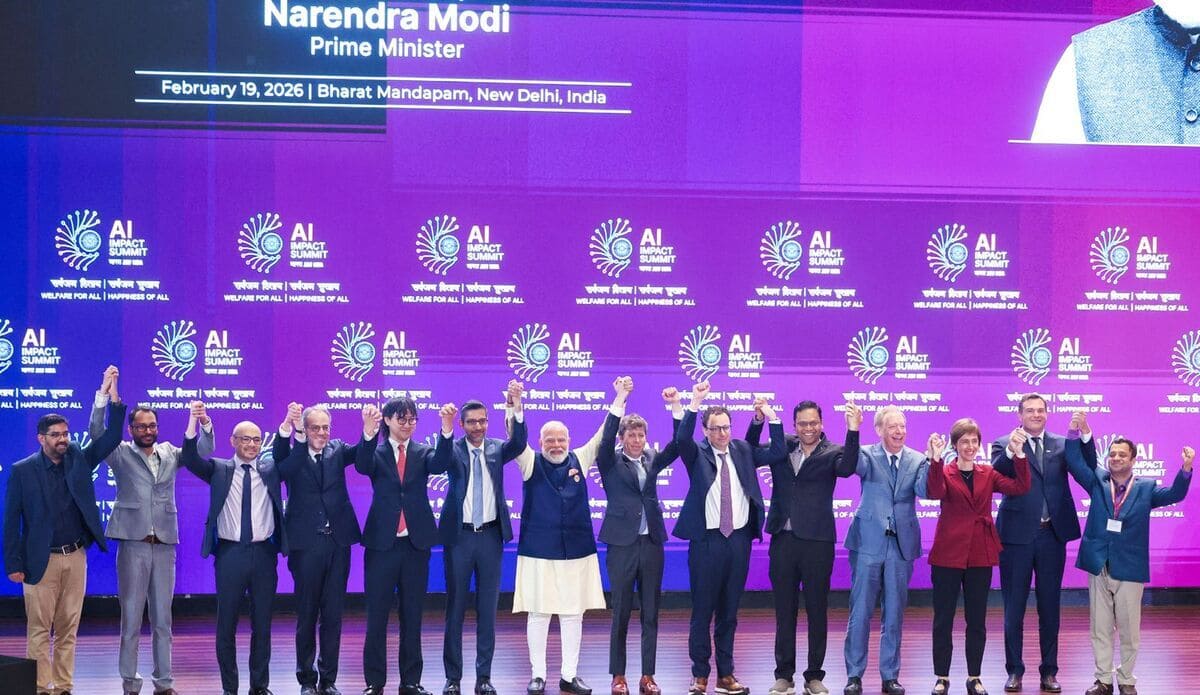
The summit’s attempt to project a seamless alliance between the Indian state and global tech leaders fractured during a high-stakes photo opportunity. Prime Minister Narendra Modi attempted a “unity hand-raise” with industry titans, but the moment turned into an international embarrassment when OpenAI CEO Sam Altman and Anthropic CEO Dario Amodei—bitter commercial rivals—refused to clasp hands, opting for awkward, raised fists instead.
Altman later admitted to being “confused” by the scripted gesture, stating, “Modi grabbed my hand and put it up, and I just wasn’t sure what we were supposed to be doing. I thought it was the open clock”. This physical disconnect has been characterized by observers as a metaphor for the broader friction between the Indian government’s messianic rhetoric and the reality of global tech competition.
The “Orion” Hardware Scandal
The integrity of India’s domestic R&D faced a major crisis of confidence following the “Orion” scandal. Galgotias University presented a robotic dog named “Orion” as a breakthrough in domestic innovation, only for investigators to identify the hardware as a mass-produced Unitree Go2 from China.
[ 2026 के इंडिया एआई इम्पैक्ट समिट की विफलताओं का विवरण: ऑडियो विश्लेषण ]
The university was ordered to vacate the premises after video surfaced of representatives claiming the Chinese hardware as their own. The political fallout was immediate, with opposition leaders accusing the government of using “Made in India” labels as a branding exercise to mask a vacuum in genuine technological research.
Logistical Collapse and Security Failures
Despite being billed as a sophisticated global milestone, the summit’s operational integrity reportedly evaporated within hours of opening. Attendees and exhibitors described a logistical collapse at the Bharat Mandapam venue, citing:
- Systemic Overcrowding: Hour-long queues and extreme congestion that stifled high-level networking.
- Resource Scarcity: Limited access to basic necessities, including food and water, for guests and exhibitors.
- Security Lapses: Reports of products being stolen directly from expo floor stalls.
Opposition leader Rahul Gandhi characterized the event as a “disorganized PR spectacle” and raised concerns that the chaotic environment left Indian data vulnerable, claiming it was effectively “up for sale”.
Leadership and Intellectual Scrutiny
The event has reignited intense political scrutiny regarding Prime Minister Modi’s ability to engage with complex technological subjects without a script. Critics pointed to his total reliance on teleprompters and his historical refusal to answer unscripted questions as evidence of a “leadership smokescreen”.
The “RMN Digital” report further suggests that India’s IT sector is struggling with a “frantic struggle for survival,” lacking foundational technical literacy even as it attempts to pivot from labor-intensive models to AI-driven platforms. Without a fundamental shift toward transparency and genuine R&D, analysts warn that India’s AI ambitions risk becoming a permanent state of “functional non-existence”.
